When parents start researching martial arts for their kids, the two names that come up most often are Brazilian Jiu-Jitsu (BJJ) and Karate. Both are legitimate martial arts with long histories and real benefits. Both teach discipline, respect, and physical fitness. But they're fundamentally different in approach, and those differences matter — especially when you're choosing the right fit for your child.
As a BJJ academy, we have an obvious bias. But we'll do our best to be fair here, because the honest truth is that a great karate school is better than a bad BJJ school, and vice versa. What matters most is the quality of instruction and the culture of the academy. That said, there are real, structural differences between BJJ vs karate for kids that are worth understanding.
Grappling vs. Striking: The Fundamental Difference
Karate is primarily a striking art. Students learn punches, kicks, blocks, and kata (prearranged movement sequences). Training focuses on speed, power, and precision in delivering and defending against strikes.
BJJ is a grappling art. Students learn to control opponents through holds, pins, sweeps, and submissions — all on the ground. There is no punching or kicking in BJJ. Training focuses on leverage, positioning, and technique that allows a smaller person to control a larger one.
For kids, this distinction has practical consequences. In a grappling art, children train at full resistance with partners every class. They wrestle, scramble, and problem-solve in real time. In many karate programs, sparring is limited or choreographed, which means students may not develop the ability to apply their techniques against a resisting opponent.
Self-Defense Effectiveness
This is where BJJ has a significant, well-documented advantage. Most real-world physical confrontations end up on the ground — especially among children. Schoolyard incidents typically involve grabbing, pushing, tackling, and pinning — all grappling scenarios. A child trained in BJJ knows exactly how to respond to these situations: how to regain their feet from the ground, how to escape a pin, and how to control someone without throwing a punch.
Karate teaches children to strike, which can be effective in certain situations but presents a problem: a child who punches or kicks a bully at school faces the same consequences as the bully. A child who controls and pins a bully without striking has a completely different disciplinary outcome. This is a practical reality that many parents overlook when evaluating martial arts for self-defense.
Anti-Bullying: Which Art Is Better?
BJJ has become the martial art of choice for anti-bullying programs, and for good reason. The ability to neutralize a bully without hurting them is exactly what schools and parents want. A child trained in BJJ can hold a bully down and wait for a teacher without throwing a single punch. They can escape being pinned against a locker. They can break free from a headlock.
Karate teaches children not to be victims, and the confidence it builds is genuine. But when it comes to the specific physical scenarios children face with bullies, grappling skills are more directly applicable. At Labyrinth BJJ, we incorporate age-appropriate anti-bullying scenarios into our kids curriculum precisely because this is the #1 reason families come to us.
Physical Fitness: How They Compare
Both martial arts provide excellent physical conditioning, but they develop different attributes:
Karate emphasizes flexibility, speed, explosive power, and cardiovascular endurance. The repetitive practice of kicks and stances builds strong legs and core stability. Kata practice develops coordination and body awareness.
BJJ emphasizes full-body functional strength, grip strength, flexibility, and sustained cardiovascular work. A single BJJ roll engages nearly every muscle group simultaneously. The constant scrambling, bridging, and hip movement builds athletic ability that transfers directly to other sports.
If we're being honest, BJJ tends to provide a more complete physical workout because every class involves grappling against a resisting partner at some point. This full-resistance training creates a conditioning effect that's difficult to replicate with drills alone.
Safety: Which Is Safer for Children?
Parents are right to worry about safety, and this is an area where both arts deserve credit. Injury rates in children's martial arts are generally lower than in team sports like football, soccer, or basketball.
That said, BJJ has a structural safety advantage: there is no striking. Children never get punched or kicked during training. Injuries in BJJ are almost exclusively minor — bruises, mat burns, the occasional rolled ankle. Submissions are taught with clear rules: tap early, tap often, and your partner releases immediately. This "tap" mechanism gives children complete control over when a technique stops.
In karate sparring, even with protective gear, there is inherent risk from strikes. Most quality karate schools manage this risk well, especially for younger students. But the absence of striking in BJJ eliminates an entire category of potential injury.
Competition Opportunities
Both arts offer robust competition circuits for kids. Karate has point-sparring tournaments and kata competitions. BJJ has grappling tournaments at the local, state, national, and international levels.
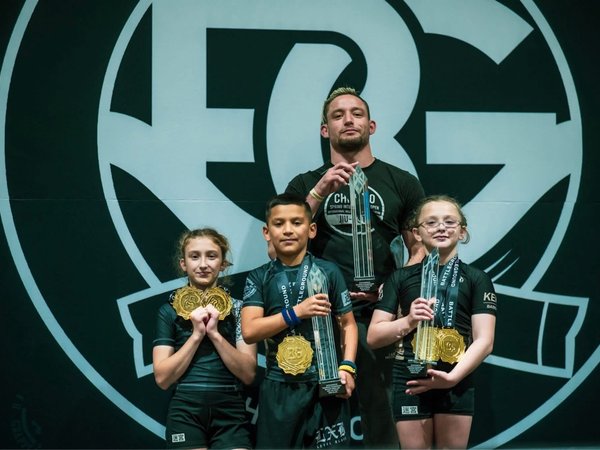
One advantage of BJJ competition is that matches are won by control, points, and submissions — not by who lands more strikes. For parents, watching their child compete in a BJJ tournament is considerably less stressful than watching a striking match. At Labyrinth, our competition team has earned over 267 gold medals and 890+ wins, and our coaching staff has deep experience preparing young athletes for tournament success.
When Karate Might Be the Better Choice
We said we'd be fair, so here it is. Karate might be the better choice if:
- Your child is uncomfortable with close physical contact. BJJ requires constant clinching, holding, and grappling. Some children aren't comfortable with this at first. Karate maintains more personal space during training.
- Your child prefers individual practice. Kata allows kids to practice alone, perfecting movements without needing a partner. BJJ always requires a training partner.
- You want a striking-focused art specifically. If your goal is to develop striking skills — for future kickboxing, MMA, or personal interest — karate is the right starting point.
- The karate school near you is excellent and the BJJ school isn't. A great school in any art beats a mediocre school in the "right" art.
When BJJ Is the Clear Winner
BJJ is the stronger choice if:
- Self-defense is your primary goal. Grappling is more applicable to real-world scenarios, especially for children.
- Anti-bullying preparedness matters to you. The ability to control without striking is uniquely valuable.
- You want full-resistance training from day one. BJJ students grapple with real resistance in every class.
- Your child is smaller than peers. BJJ is specifically designed to help smaller people overcome larger opponents through technique and leverage.
- You want a lifelong sport. BJJ can be practiced safely well into old age and has an active adult recreational community.
Our Recommendation
At Labyrinth BJJ, we obviously believe in what we teach. But our recommendation isn't "choose BJJ because we say so." It's this: visit both schools. Watch a kids class at each. Talk to parents whose children train there. See which environment your child responds to. The best martial art for your kid is the one they'll actually want to attend week after week.
That said, if you're prioritizing self-defense, anti-bullying skills, and full-body fitness — and you want your child training at the #1 ranked academy in Texas — we'd love to see you on our mats. Check our class schedule to find a time that works for your family.